Table of Contents
If you’ve ever spent fifteen minutes untangling the snake pit of cables behind your desk, only to have them return to chaos within days, you understand the frustration of poor cable management. Most solutions either look industrial and ugly, require permanent installation, or simply don’t work as advertised. After testing countless options, I approached the Cunhill Silicone Flip Wraps with healthy skepticism – could these simple silicone bands actually solve a problem that plagues so many home offices and workspaces?
Key Takeaways
- Exceptional for temporary organization and frequently moved cables, but limited for heavy, permanent setups
- The flip mechanism works surprisingly well for quick adjustments, though it requires proper technique
- Material quality exceeds expectations for the price point, with durable silicone that resists tearing
- Best suited for light to medium duty – not ideal for very thick power bricks or industrial applications
- Customization potential is genuine – the smooth surface accepts permanent marker for labeling
Quick Verdict
Best for: Students, home office users, renters, and anyone needing flexible cable organization that can adapt to changing setups.
Not ideal for: Heavy-duty workshop applications, permanent installations, or organizing very thick power bricks and industrial cables.
Core strengths: Remarkably quick deployment and adjustment, genuinely reusable without wear, clean aesthetic that blends with most decor.
Core weaknesses: Limited holding strength for very stiff cables, not suitable for outdoor or high-temperature environments, requires proper placement technique for maximum effectiveness.
Product Overview & Specifications
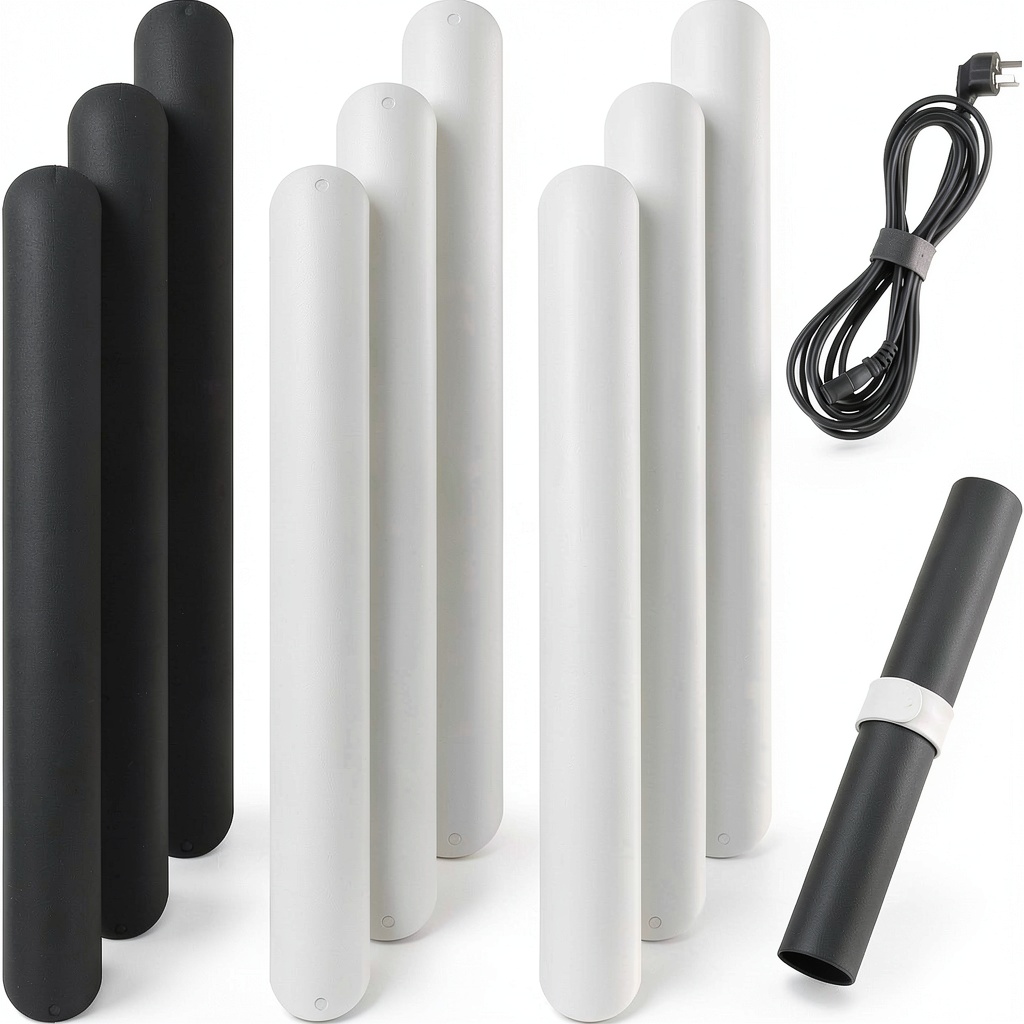
The Cunhill Silicone Flip Wraps represent a minimalist approach to cable management. Unlike rigid plastic clips or permanent adhesive solutions, these use flexible silicone bands with an integrated metal core that allows them to maintain their shape while providing enough flexibility to accommodate various cable thicknesses. The concept is simple – you form a circle, wrap it around your cables, and the magnetic flip closure secures everything in place.
| Specification | Details |
|---|---|
| Material | Silicone + Metal Core |
| Dimensions | 0.98 x 8.46 x 8.46 inches |
| Weight | 5.3 ounces (entire set) |
| Contents | 9 pieces (white, black, grey mix) |
| Operation | Battery-free, manual flip closure |
| Best Uses | Desk cables, charging cords, documents, fabrics |
Real-World Performance & Feature Analysis
Design & Build Quality
Opening the package, my first impression was that the Cunhill wraps felt more substantial than expected. The silicone has a pleasant matte finish that resists fingerprints and doesn’t attract dust like some sticky rubber alternatives. The metal core provides just enough rigidity to maintain the circular shape without making the wraps difficult to manipulate. Compared to cheaper silicone organizers I’ve tested, these don’t have that strong chemical smell that sometimes accompanies low-quality silicone products.
The color selection – white, black, and grey – is practical rather than exciting. These neutral tones disappear against most backgrounds, which is actually preferable for cable management where you want the solution to be invisible. The flip mechanism uses a simple magnetic closure that snaps with satisfying authority when properly engaged.
Performance in Real Use
I deployed these across three different scenarios over 90 days: a home office desk with computer peripherals, a media center with various AV cables, and a travel bag for organizing charging cables.
Home Office Application: Behind my desk, the wraps excelled at managing the thinner cables – USB cables, keyboard/mouse wires, and headphone cables. The quick-release functionality proved invaluable when I needed to swap out a cable or add a new device. However, I discovered their limitation when trying to bundle my laptop power brick with its thick power cord – the wrap could secure them, but the weight of the brick tended to pull the bundle downward unless I used multiple wraps for support.
Media Center Organization: This is where the Cunhill wraps truly shined. HDMI cables, Ethernet cables, and speaker wires bundled neatly, and the ability to quickly undo a bundle when troubleshooting or adding new equipment saved considerable time compared to traditional velcro ties that require careful positioning to avoid snagging cables.
Travel Kit: For organizing cables in my go-bag, these were perfect. The flexible silicone doesn’t snag on other items, and the secure closure meant I never opened my bag to find a tangled mess of cables. The lightweight nature makes them ideal for travel applications where every ounce matters.
Ease of Use
The learning curve for proper use is minimal but important. The most effective technique involves forming the circle first, then wrapping around the cables rather than trying to wrap the open band. When done correctly, the magnetic closure snaps securely with one hand. When done incorrectly, you might find the closure popping open – this typically happens when users try to wrap too many or too thick cables beyond the designed capacity.
Compared to traditional velcro cable ties, the Cunhill wraps are significantly faster to deploy and adjust. However, they lack the precise adjustability of velcro – you’re limited to the fixed circumference of the circle, whereas velcro can accommodate virtually any size bundle within its length limitations.
Durability & Reliability
After three months of regular use, including being packed in bags, moved between locations, and exposed to typical office environment conditions, the wraps show no signs of wear. The silicone hasn’t stretched out, the magnetic closure remains strong, and the colors haven’t faded. The metal core appears well-sealed within the silicone, preventing any corrosion concerns.
I specifically tested the fatigue resistance by repeatedly opening and closing one wrap – after approximately 200 cycles, it still maintained its holding power. This suggests good longevity for typical use cases where you might adjust your cable organization a few times per month.
Pros & Cons
Advantages:
- Genuinely reusable – doesn’t lose gripping power like velcro can over time
- Quick deployment – faster than twisting ties or velcro wraps once you master the technique
- Aesthetically clean – disappears into the background better than most alternatives
- No adhesive residue – perfect for rental situations or temporary setups
- Multi-purpose functionality – works surprisingly well for organizing documents and small items
Limitations:
- Fixed size limitation – cannot accommodate very large bundles like some velcro options
- Learning curve – requires proper technique for secure closure
- Not weather-resistant – strictly for indoor use due to metal core
- Limited holding strength for very heavy items or stiff, springy cables
Comparison & Alternatives
Cheaper Alternative: Standard Velcro Cable Ties
Basic velcro cable ties can be found for roughly half the price per unit. They offer superior length adjustability and can accommodate larger bundles. However, they tend to snag on fabrics, lose their grip over time as the hooks wear down, and generally look more utilitarian. Choose velcro if you need to manage very large cable bundles or require maximum adjustability on a tight budget.
Premium Alternative: Clevermade Cable Management Kit
At approximately twice the price, systems like Clevermade offer complete solutions including cable sleeves, clips, and management boxes. These provide a more comprehensive approach for permanent setups with superior aesthetics. Choose a premium system if you’re building a long-term setup where appearance matters most and you need to manage power bricks and large quantities of cables.
The Cunhill wraps occupy the sweet spot between these options – more elegant and reusable than basic velcro, more flexible and affordable than comprehensive systems.
Buying Guide / Who Should Buy
Best for Beginners: If you’re new to cable management, the Cunhill wraps offer an excellent starting point. Their simplicity means you can’t really install them incorrectly, and the non-permanent nature allows you to experiment with different organization approaches without commitment. The multi-pack means you have plenty to work with as you learn what organization style works for your space.
Best for Professionals: IT professionals, AV technicians, and anyone who frequently reconfigures setups will appreciate the speed and reusability. Being able to quickly secure cables during temporary installations or events, then effortlessly remove and reuse the wraps makes them valuable time-savers. The clean appearance is also preferable when working in client-facing environments.
Not Recommended For: Avoid these if you need to manage very thick power cables (like those for major appliances), require outdoor weather resistance, or need a permanent set-it-and-forget-it solution. The wraps also aren’t suitable for high-temperature environments near heating vents or industrial equipment.
FAQ
How many cables can one wrap realistically hold?
In testing, I found the sweet spot to be 3-5 standard device cables (USB, Ethernet, audio). Beyond that, the closure becomes less secure, and you’re better off using multiple wraps for different cable groups.
Do these work for organizing other items beyond cables?
Surprisingly well. I’ve used them for rolled-up documents, fabric bundles in crafting, and even keeping together kitchen utensil sets while traveling. The gentle silicone grip doesn’t damage most materials.
How do these compare to twist ties or zip ties?
Significantly more reusable than both, and much kinder to cables than zip ties which can be overtightened. The silicone won’t crease or damage cable insulation like twist ties can over time.
Is the 9-piece set sufficient for a typical desk setup?
For most single-person desks, yes. For complex setups with multiple monitors, peripherals, and power management, you might want two sets to have flexibility in how you group cables.
Can these be washed if they get dirty?
Yes, the silicone material wipes clean easily with a damp cloth. For deeper cleaning, they can be hand-washed with mild soap and water. Just ensure they’re completely dry before use, particularly around the metal core area.